
NVIDIA CES 2026 Announcements – no new Gaming GPUs but plenty of new features.
At CES 2026 in Las Vegas, NVIDIA set the tone for the year ahead with a slate of announcements spanning next-generation AI computing platforms, gaming technology advances, cloud gaming expansion, and new display technologies. From breakthroughs in physical AI and autonomous systems to upgrades for gamers and creators everywhere, NVIDIA demonstrated how AI is expanding into every corner of computing and real-world automation. What it didn’t do is announce any new video cards. The normal cadence NVIDIA has of releasing “SUPER” upgrades mid way through a GPU’s lifecycle has been delayed, and we don’t realistically expect a change to their line up of cards for another 12 months. NVIDIA has once again proven it has become an “AI-first” company, a seismic realignment from its many years rooted in the consumer graphics industry.

Rubin - NVIDIA's next-gen AI Platform
NVIDIA’s keynote announced the Vera Rubin AI computing platform, a massive new hardware stack that integrates six custom chips including a Vera CPU and Rubin GPU, alongside high-speed interconnects and Data Processing Units. According to NVIDIA, the Rubin GPU alone delivers up to five times the AI training performance of the previous Blackwell generation, and the full platform can train complex models much more efficiently and cost-effectively. Rubin-based systems are already in full production with partner deployments expected in the second half of 2026. This will be of little interest to anyone outside the AI hardware industry, but will lead to more sophisticated, powerful LLMs that you will eventually see the benefits of when you use your favourite AI assistant. Will it finally make Alexa smart? Sorry, I don’t know that.
DLSS 4.5: Smoother gaming on modest hardware
Love it or loath it, NVIDIA is doubling down on its frame generation technology. Given the fantastic benefits it gives in some games – especially flight simulation and other games where twitchy reflexes are less relevant, we are not necessarily disappointed. DLSS 4.5 introduces:
– A 2nd-gen transformer AI model for significantly improved Super Resolution image quality
– Dynamic Multi Frame Generation, which automatically adjusts frame generation based on workload and display refresh rate
– A new 6X Multi Frame Generation mode, generating up to five AI frames per rendered frame
These improvements promise both sharper visuals and higher performance on GeForce RTX GPUs, particularly in 4K gaming with path tracing enabled.
A slew of upgrades for AI PC users
If you use your PC as an AI workhorse, there are a whole host of upgrades on the way for you, making your home PCs much more powerful for so-called “SLMs”, or small language models. These close the gap on cloud based LLM technologies and allow users to make use of generative technology without compromises in privacy, security or latency.
- Up to 3x performance and 60% reduction in VRAM for video and image generative AI via PyTorch-CUDA optimizations and native NVFP4/FP8 precision support in ComfyUI
- RTX Video Super Resolution integration in ComfyUI, accelerating 4K video generations
- NVIDIA NVFP8 optimisations for the open weights release of Lightricks’ state-of-the-art LTX-2 audio-video generation model
- A new video generation pipeline for generating 4K AI video using a 3D scene in Blender to precisely control outputs
- Up to 35% faster inference performance for SLMs via Ollama and llama.cpp
- RTX acceleration for Nexa.ai’s Hyperlink new video search capability
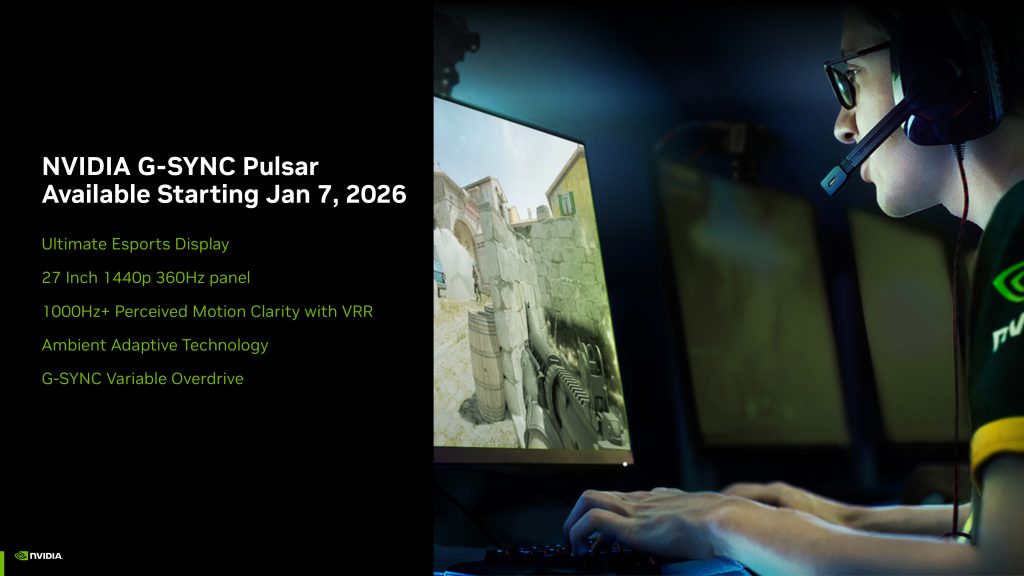
G-SYNC Pulsar: Next-Gen Display Tech
CES also saw the unveiling of G-SYNC Pulsar, NVIDIA’s latest evolution of its adaptive-sync display technology. Pulsar promises to reduce motion blur and deliver smoother visuals on high refresh-rate monitors, with new panels from multiple partners launching this year.
The new technology combines variable refresh rate with improved backlight control to optimise motion clarity without sacrificing tear-free performance – a leap forward for competitive gaming and high-fps visuals. Monitors from AOC, Acer, ASUS, and MSI should available from early January 7th, 2026, starting at just £599.
Robotics, Autonomous Vehicles & Physical AI
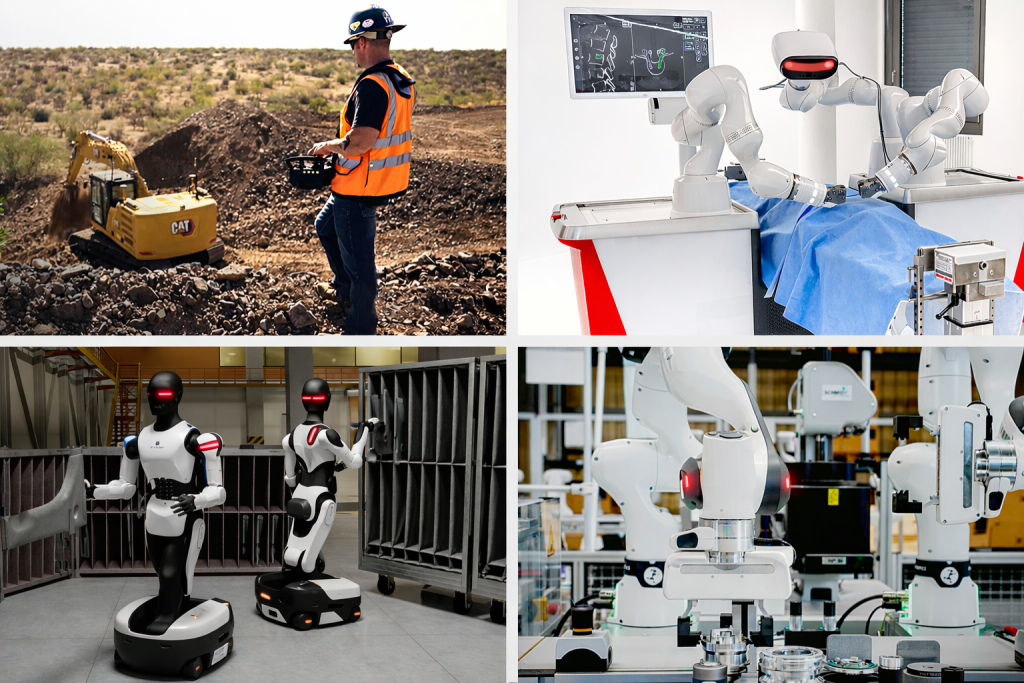
Beyond AI chips and gaming technology innovations, NVIDIA showcased its vision for physical AI — AI systems that reason and act in the real world.
These incvlude;
Open AI models and frameworks for robotics and autonomous machines.
An AI model called Alpamayo for autonomous driving designed to bring reasoning capabilities to vehicles encountering rare and complex scenarios.
Demonstrations of autonomous robots from global partners using NVIDIA’s Cosmos and GR00T models.
All of this has happened before and will happen again, so say we all.
What do we think?
Of course it is hard not to be disappointed that new GPUs for gamers have been delayed, but NVIDIA did at least release some exciting new display technologies that will add extra quality, features and smoothness for existing users, and we can’t help but think the main reason new RTX 5000 series cards haven’t been released is because they just don’t need to be. The RTX 5080 and 5090 sit essentially un-challenged at the high end, and NVIDIA has been given an absolute beating by the press in previous years for introducing “needless complexity” and “iterative updates” to well-established ranges with Super cards previously. Be careful what you wish for!